The Key to Successful AI Agent Rollouts: Building Trust
London, May 7 2026

Matthew Lim

Deploying AI fast and deploying it well are increasingly at odds. When organisations treat rollout as a technology project alone, they tend to underestimate the cultural work required to make it stick. The result is software that is technically live but practically ignored.
Trust is what gives teams the confidence to move away from old workflows and shadow spreadsheets. Drawing on lessons from our work with global manufacturers and producers, this article looks at the role of Forward Deployed Engineers (FDEs) in earning that trust and how to build it in by design.
AI Agents are speeding up time to value
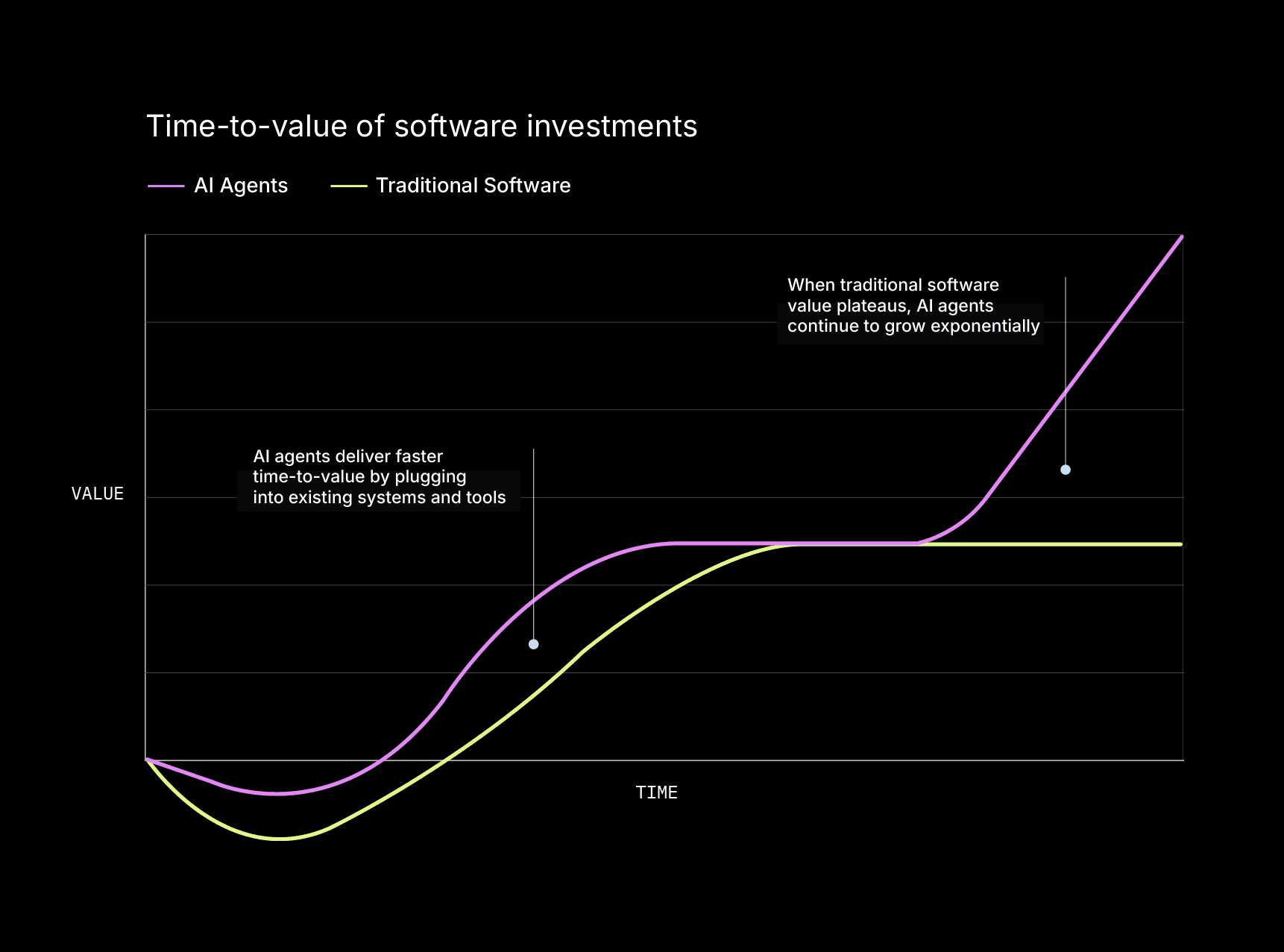
In software, time to value (TTV) measures how quickly an investment turns into measurable ROI.
For enterprise platforms, this has traditionally followed a familiar “hockey-stick” curve: a long, flat period during implementation and rollout, followed by a sharp rise once people start using the system in their day-to-day work.
With traditional software, that flat part of the curve is painfully long. Integrating with legacy systems, consolidating fragmented data, and validating quality can push value realisation out by years.
AI Agents compress that flat line. Most modern AI platforms sit as a distinct layer on top of existing systems such as SAP, Coupa, and Oracle. Instead of ripping and replacing core infrastructure, companies can orchestrate workflows across what they already have. That means value often shows up within weeks once AI Agents go live. At Magentic, that’s what we’re seeing consistently.
Organisational readiness: the new bottleneck
Given this acceleration, it’s striking how many large enterprises still report little realised value from AI initiatives. Fast deployment should, in theory, lead to faster ROI. In practice, many projects stall after launch.
Some of this comes down to the use case, e.g back-office operations often see larger, more immediate returns than front-office applications. But a large part comes down to organisational readiness.
Well-run companies move People, Process, and Technology together. With AI, Technology often sprints ahead while People and Process are still walking. Most organisations aren’t slow because they are poorly run. They move carefully because work requires coordination across teams and built-in checks and balances. Data access may require approval from three different functions. Security reviews run on fixed cadences, irrespective of what’s queued. Steering committees meet monthly, whether or not urgency demands a faster decision.
These structures are part of how large organisations maintain control and manage risk. But when technology moves on a different beat, the misalignment becomes the bottleneck.
A large part of our rollout work at Magentic is focused on aligning the three together so that deployments turn into real, compounding value.
Change management in the AI era
That work can’t rely on long user guides and training alone. Adoption only happens when the product meets people where they already are.
Platforms need to adapt to users just as much as users need to adapt to new technology. When deploying AI Agents, that means trust needs to be built in from the start. At Magentic, that looks like clear visibility into the AI Agents’ inner workings: which data they used, where that data came from, and how they reached their conclusions. That is what turns a suggestion into something people are willing to execute.
A large part of the role of the FDE is making sure that the platform speaks the user’s language. Sometimes that’s literal; more often, it’s about context. A field engineer ordering spare parts and a head office trader managing commodities do not think in the same terms. If users can’t see their own work reflected in the product through labels, flows, and metrics that map to how they operate, they won’t trust it enough to change how they work. Work will keep flowing through old paths, and the new system will remain optional instead of becoming the default.
The role of Forward Deployed Engineers
Forward Deployed Engineers (FDEs) close that gap between the platform and the way work actually happens.
The platform does the heavy lifting across systems. FDEs embed directly into customer operations to surface everything those systems don’t capture: institutional knowledge, workarounds, and gaps. Enterprise deployments still need these moments to understand fifty years of ERP customisation, the contracts that never made it into CLM and now live on shared drives, and how global and local teams treat the same agreements differently.
Being on the ground is the difference between a configuration and a fit. At one customer, a category manager was tracking volume obligations in a spreadsheet because nothing in the system flagged them. Once our FDE found it, they mapped the real calculations into the platform so AI Agents could accurately flag missed discounts. Without that, the category manager would have had no reason to give up the spreadsheet, and we wouldn’t have earned their trust.
We see this work pay off in two moments we care about most. The first is when a user trusts the evidence and acts on a recommendation that creates value for them, their team, and the company. The second is when, after rollout, users come back with their own ideas for how to extend Magentic further. That moment matters more than it sounds. It means the platform has shifted from something done to them to something they feel ownership over. They understand it well enough to spot workflows we haven’t built yet and use cases we hadn’t considered.
When that happens, the deployment isn’t finished. It’s just getting started.