5 Lessons on Driving AI Agent Adoption From Global Manufacturers
London, May 22, 2026

Philip Marshall-Lockyer

As one of Magentic's first hires, I've watched AI Agents take hold in procurement.
When I joined, they were still more talked about than deployed. A year later, they are drastically changing how work gets done whilst delivering results at a scale that traditional software never could.
Speaking with teams across the globe, I've picked up on what companies do well. One thing that stands out is that those who drive adoption the fastest reap the most benefits by far.
Below are five ways of building that early traction, touching on all key players: the buyers, the adopters, and the users.
1. Begin adoption efforts early - for everyone
According to a report by MIT Nanda, unwillingness to adopt is the most common cause of failed GenAI implementations.
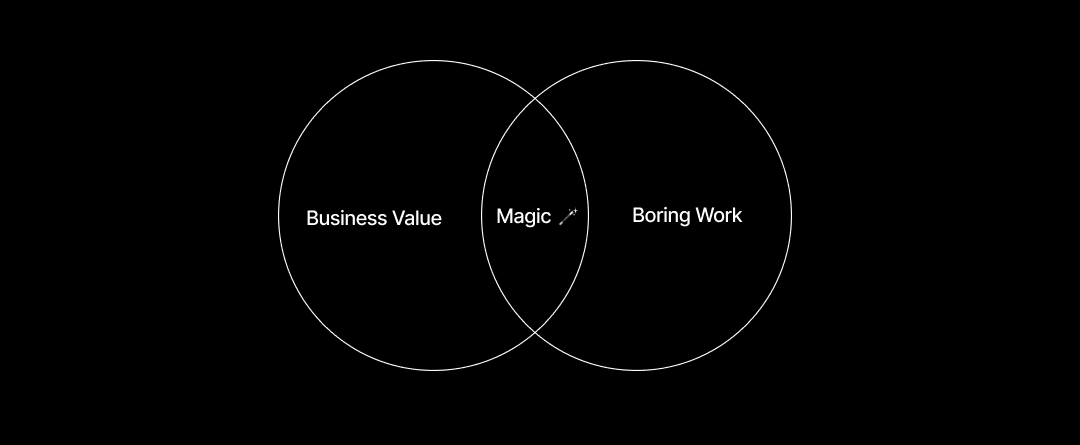
This can be avoided by bringing users into the process early, ideally at the buying stage. The old saying that 'time kills deals' applies to adoption as well; lengthy processes drain excitement, while early movement creates curiosity and energy. This early momentum kicks off a virtuous cycle of benefits: The experience, product performance, and adoption itself. This is the 'magic' of AI Agents.
The more people who are involved from the outset, the better the outcomes. When users can question outputs, correct mistakes, and see the system improve, trust builds through use. These feedback loops improve performance whilst simultaneously embedding the team's knowledge directly into the system.
There is also a clear economic case. Every month you wait, you continue to pay for manual work that could be automated: It is the unmeasured opportunity cost of moving slow. Earlier adoption means your AI spend, goes further by freeing up time and salary for higher-value work.
The right vendor makes this feel easier. There is now a wealth of mature, plug-and-play agentic platforms on the market. A good partner manages integration, data protection, and workflow setup in the background. Managed well, these steps should feel almost invisible to the internal team.
2. Start with high-impact, low-effort use cases
Ten years into SaaS, teams have come to expect heavy lift and delayed reward as the cost of digital transformation. With AI Agents, that trade-off no longer applies.
The beauty of agentic software is that value appears almost immediately. These early, visible wins are important to prove that the system works in practice, which justifies the investment and drives engagement.
Speed is compelling. But to move fast, the gain must clearly outweigh the effort. Low effort puts you in the driving seat by giving you the luxury of choice. Lengthy implementations, by contrast, accumulate costs and turn rollouts into a source of frustration.
When selecting initial use cases, focus on those with high impact and clear visibility. They are not always the most obvious on paper. In one case, Magentic's AI Agent identified a contractual detail a supplier had not honoured and saved close to a million dollars. Similar value came from a routine re-negotiation with a supplier. Guess which story was told at the customer town hall?
The numbers should be large, visible, and measurably tied to your targets. If they are not, you are probably starting with the wrong problem.
If the right partner makes adoption feel like Magic, the right use case makes AI Agents make sense.
3. Focus on output over decoration
Custom interfaces are no longer the barrier they once were.
Obsessing over slick front-ends is a distraction that pulls focus from what actually matters: The true value the platform drives. This obsession made sense in the past, but it is a hangover from legacy software. In 2026, a decent interface can be spun up in a day using tools like Stitch and pencil.dev. If your AI partner cannot develop one easily, that is a significant red flag about their ability to build the tool itself.
Design choices should follow data about what works, not personal taste. Data beats intuition when it comes to predicting how people will actually use interfaces. Most of the time, a good agentic front-end is simply a chat window - the same pattern we have been refining since the days of Talkomatic, long before AOL or MSN.
Focus instead on the quality of the output. How reliably does the system reduce errors and inform decisions that teams can trust? Poor performance ranks as the second most common reason deployments stall, according to MIT Nanda. Reliable output, by contrast, drives the business case. When the system consistently delivers decisions teams can trust, everything else falls into place.
The goal is to arm teams with the most capable intelligence available on the market. Nine times out of ten, that means design choices like model agnosticism and rigorous evals, which drive the performance needed to get you into those town hall moments.
4. Make the learning loop painless
However good the underlying model, AI Agents need time to adapt to a company's systems and processes.
Real value emerges through iteration. Learning loops drive trust, which erodes unwillingness to adopt new tools. But giving feedback frankly sucks - it takes effort and time. For it to happen consistently, that feedback needs to feel natural and frictionless.
This can be designed through:
Traceable reasoning. Feedback becomes easier when users can follow the AI Agent's logic. Every decision should surface its reasoning in plain language: Where the process veered off, which signals drove that step, and how the outcome took shape.
Low-friction feedback. Feedback only scales when it is dead simple to give. Small, intuitive corrections should take seconds to articulate and deliver visible improvements next time.
Capturing tribal knowledge. People are more willing to share input when they can see it shape outcomes. When input is directly reflected in the platform, trust grows and contributing feels worthwhile.
When learning feels seamless rather than laborious, adoption follows.
5. Automate the work humans find least fun
People determine whether projects succeed or stall. Spend time making the team experience excellent. We have all used ChatGPT to handle the tedious parts of our work. Lean into that instinct to drive adoption. Start automation where it is most welcome: The repetitive, time-consuming tasks no one enjoys.
Once teams see AI Agents taking on work nobody misses, interest grows naturally. Demand grows for AI Agents to support other areas, including higher-value, strategic work.
Technology and the right partners matter greatly, but never underestimate leadership. I still remember a perceptive CIO who set out our vision for his team, from first principles, before we had even fully pitched it. He made our case better than we could, and turned scepticism into enthusiasm overnight.
A final note: Driving adoption should be easy
In functions like procurement, where complexity has long been part of the job, AI Agents simplify work by unifying fragmented systems, cleaning data on the fly, and improving operational efficiency across the board.
Start where the pain is worst, make results visible fast, and watch curiosity turn into demand. Early wins turn push to pull - a pattern we are seeing across our customer base. Once teams experience that magic of AI Agents, they actively ask for more.
Work with a partner who keeps things simple and enjoyable. Contrary to popular belief, deploying AI Agents need not be complex or demand large upfront investments. In fact, implementing AI Agents is often simpler than rolling out traditional software, because they do not require perfect data or a complete systems overhaul. Most of Magentic's customers go live within weeks (if not days).
If you're figuring out where to begin, I'm always happy to chat. Book a demo here.